What is Poisson Ratio: The Unseen Force That Moves Materials.
A rubber band becomes thinner when you stretch it. When foam cushion is compressed, it swells out. What appears to be a very simple behaviour is dictated by one of the most basic principles in solid mechanics: Poissons Ratio.
It is named after the French mathematician Siméon Denis Poisson and is a dimensionless value that is important to engineers who are designing bridges, aircraft, and even smartphone screens. We will herein dissect what Poisson Ratio is, why it is important and the calculation process step by step.
What is the Poisson’s Ratio?
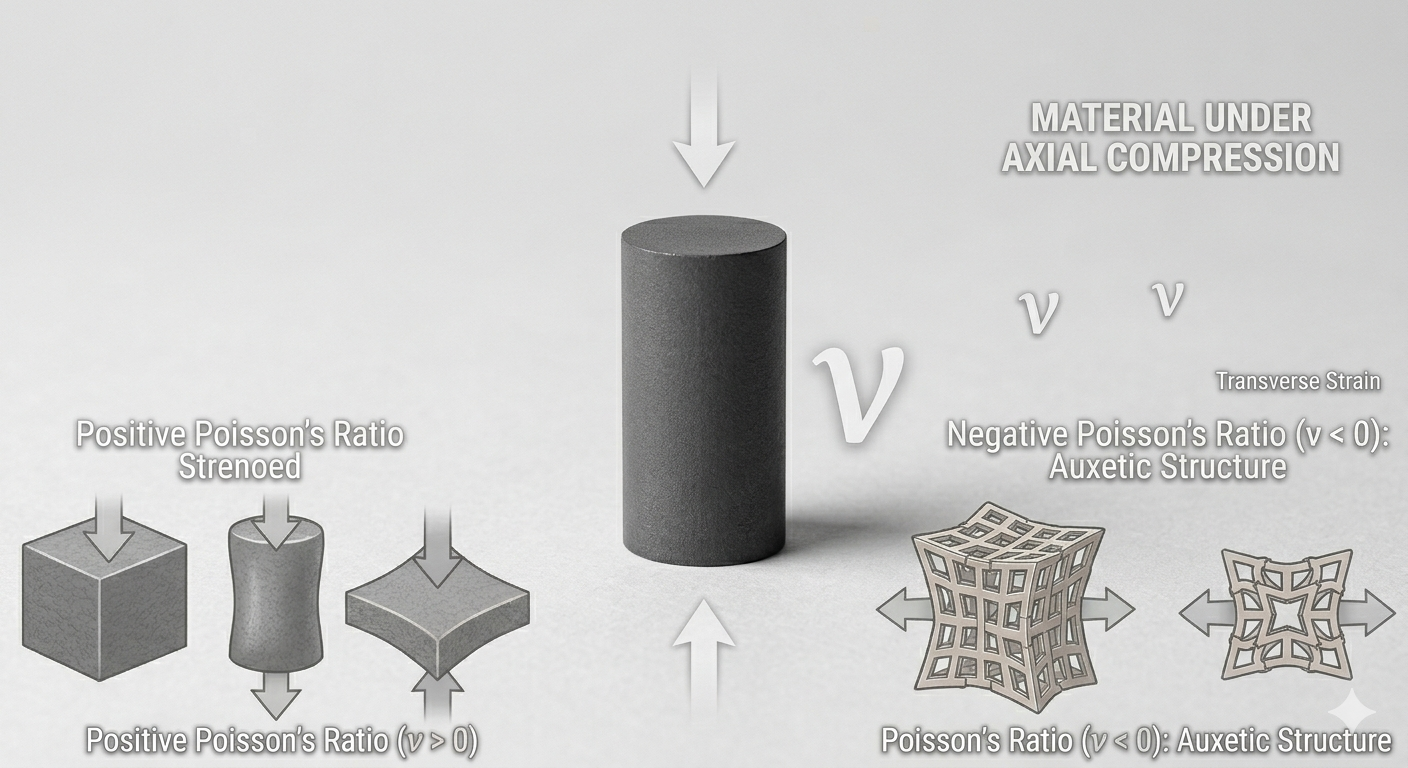
The Ratio of Strains The negative ratio of transverse to axial strain is called the Poisson Ratio (symbol ν, pronounced nu). In simple terms: as you move a material in a direction, by how much does it contract or expand in the other directions?
Axial direction: Direction of force applied.
Transverse direction: The direction which is perpendicular to the force being applied.
The ratio is positive (lateral contraction resulting due to stretching) in most common materials.
The Main Formula
The Poisson Ratio has the following definition:
$$
\nu = -\frac{\epsilon_{\text{transverse}}}{\epsilon_{\text{axial}}}
$$
Where:
ν = Poisson’s Ratio (dimensionless)
ε transverse = Lateral strain (normal to load)
εxial = Strain perpendicular to the load applied.
Calculating Axial Strain
The change of the length divided by the initial length is called the axial strain:
$$
\epsilon_{\text{axial}} = \frac{\Delta L}{L}
$$
Extending the change of length:
$$
\epsilon_{\text{axial}} = \frac{L_{\text{final}} – L_{\text{initial}}}{L_{\text{initial}}}
$$
Calculating Transverse Strain
The same form of strain, but in the lateral direction (e.g., diameter or width):
$$
\epsilon_{\text{transverse}} = \frac{\Delta d}{d}
$$
Expanded:
$$
\epsilon_{\text{transverse}} = \frac{d_{\text{final}} – d_{\text{initial}}}{d_{\text{initial}}}
$$
Step-by-Step Worked Example
Assume that the starting dimensions of a metal rod are:
Original length = 1.0 m
Original diameter = 0.01 m
Under tension:
Final length = 1.001 m
Final diameter = 0.009997 m
Step 1: Calculate axial strain
$$
\epsilon_{\text{axial}} = \frac{1.001 – 1.000}{1.000}
$$
$$
\epsilon_{\text{axial}} = 0.001
$$
Step 2: Calculate transverse strain
$$
\epsilon_{\text{transverse}} = \frac{0.009997 – 0.010000}{0.010000}
$$
$$
\epsilon_{\text{transverse}} = -0.0003
$$
Step 3: Compute the Ratio of Poisson.
$$
\nu = -\frac{-0.0003}{0.001}
$$
$$
\nu = 0.3
$$
This value ( ν= 0.3) is common with most metals such as steel and aluminum.
Relations to other elastic constants: Poisson Ratio.
The Ratio of Poisson relates three significant material properties: Youngs Modulus (E), Shear Modulus (G) and Bulk Modulus (K).
Relationship among E, G and nu.
The shear modulus is related to Young’s modulus and Poisson’s ratio by:
$$
G = \frac{E}{2(1 + \nu)}
$$
Given any two properties you can compute the third. For example, let:
E = 200 GPa
ν = 0.3
Then:
$$
G = \frac{200}{2(1 + 0.3)}
$$
$$
G = \frac{200}{2.6}
$$
$$
G \approx 76.9 \, \text{GPa}
$$
Relation between E, K, and ν.
The bulk modulus (resistance to uniform compression) is related to the Young modulus:
$$
K = \frac{E}{3(1 – 2\nu)}
$$
In case ν = 0.5, the denominator will be zero and K will be infinite – that is an incompressible material (such as rubber or water).
Experimental Span of Poisson Ratio.
When the material is a stable, isotropic material, Poisson Ratio should theoretically be in the range between -1 and 0.5:
ν = 0.5: Perfectly incompressible (rubber)
ν 0.3: Typical solids (steel, aluminum)
ν ≈ 0.1 to 0.2: Concrete and ceramics
ν = 0: No lateral deformation (cork)
0 2: Auxetic materials (rare, engineered metamaterials)
The thermodynamic stability limits are:
$$
-1 < \nu < 0.5
$$
When ν is greater than 0.5, the bulk modulus is no longer physical. In case ν is less than -1 shear modulus will be unstable.
Applications in practice in engineering.
Knowledge of Poisson Ratio can be used to assist engineers to solve real-life problems:
Pavement Design: Horizontal tensile strains due to compressing a vehicle tire vertically on asphalt are predicted by Poisson ratio, which leads to cracking.
Pressure Vessels: Internal pressure will increase the diameter (hoop stress) and length of a pipe. The two strains are connected by the effect of Poisson.
Structural Bolts: By tightening a nut the bolt becomes stretched in an axial direction and the diameter becomes slightly smaller, which is significant in thread engagement.
Auxetic Foams: These are applied in high-performance impact protection equipment since they get denser when it is stretched to absorb more energy.
Summary of major Formulas.
All the important equations of this post can be found in the following:
$$
\nu = -\frac{\epsilon_{\text{transverse}}}{\epsilon_{\text{axial}}}
$$
$$
\epsilon_{\text{axial}} = \frac{L_{\text{final}} – L_{\text{initial}}}{L_{\text{initial}}}
$$
$$
\epsilon_{\text{transverse}} = \frac{d_{\text{final}} – d_{\text{initial}}}{d_{\text{initial}}}
$$
$$
G = \frac{E}{2(1 + \nu)}
$$
$$
K = \frac{E}{3(1 – 2\nu)}
$$
Conclusion
Poisson Ratio can be a very basic idea – lengthen one end, shorten the other, but it is a mainstay of structural engineering and material science. Between 0.5 (the ν of almost incompressible rubber) and 0.2 (the ν of brittle concrete), this value will tell you how a substance will actually perform under stress.
The next time you look at a rubber band or a concrete beam, take in mind: Poisson has an invisible ratio that determines all the small deformations.
Meta Description: Understand the definition of Poisson Ratio, its formula, and its application. Has full equations of the axial strain, transverse strain, shear modulus, and bulk modulus, formatted using MathJax.
Keywords: Poisson ratio, Poisson ratio formula, axial strain, transverse strain, shear modulus, bulk modulus, material deformation, engineering mechanics, MathJax WordPress.
References
- Wikipedia: Poisson’s ratio: A comprehensive overview, including definition, history, and typical values.
- ScienceDirect: Poisson Ratio: A technical topic page explaining the formula and its measurement, with links to relevant research chapters and articles.
- Purdue University: Poisson’s Ratio: An educational page from Purdue’s ME 323 course with helpful animations and a detailed discussion of positive and negative ratios.
- Missouri S&T: Lecture Notes: Lecture notes from a course on elastic constants, offering an academic perspective on Young’s modulus, shear modulus, and Poisson’s ratio.